Niukawakami Shrine, Middle Shrine
Researched and translated with AI assistance. Every claim is linked to its source, but errors get through, so check the official site for opening times, fees and closures.About
In short
Founded on an oracle — "if you raise my shrine pillars at Niukawakami and revere me, I shall send sweet rain for the realm and stop the long rains" — and dedicated to Mizuhanome, who governs water.
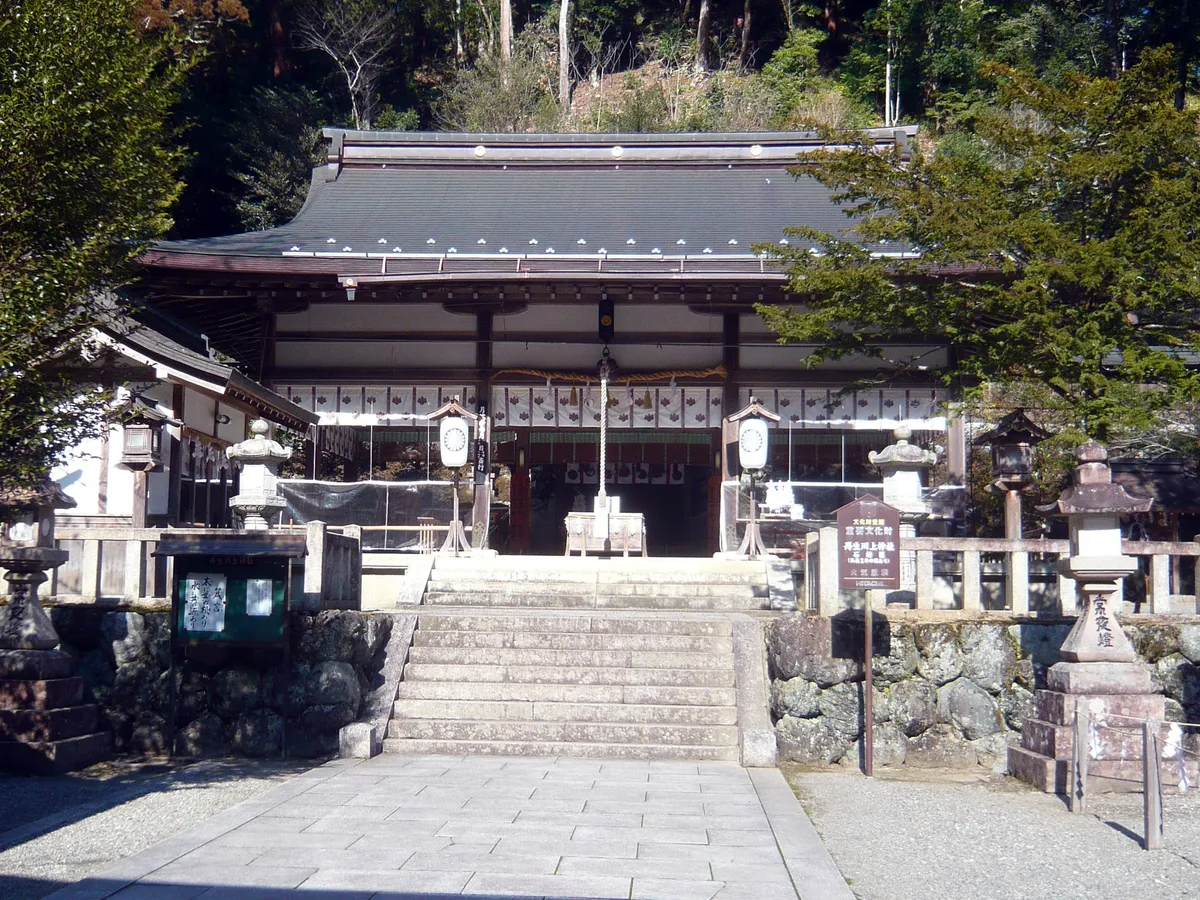
Quick facts
- Address
- 968 O, Higashiyoshino, Yoshino, Nara
- Spiritual entities
- Izanagi (伊邪那岐命) · Izanami (伊邪那美命)
About this place
Niukawakami Shrine, Middle Shrine, is in Higashiyoshino, Nara. In 675, under the fortieth sovereign Emperor Tenmu, it was founded on the oracle: "If you raise my shrine pillars and revere me at Niukawakami, in the deep mountains of Yoshino where no human voice is heard, I shall send sweet rain for the realm and stop the long rains." Its chief deity is Mizuhanome, with Izanami and Izanagi in the same hall. The Engishiki of 927 lists it among the great shrines of eminent deities, and from the middle Heian period it was counted among the twenty-two shrines as a deity of prayer for rain. On the twenty-eighth day of the fifth month of 763, during a long drought, offerings were made to the deities of the four home provinces, and at Niukawakami a black horse was presented in addition to the offerings. A black horse was presented when rain was sought, and a white or red horse when rain was to be stopped.
Origin and history
In 675, under the fortieth sovereign Emperor Tenmu, the shrine was founded on the oracle: "If you raise my shrine pillars and revere me at Niukawakami, in the deep mountains of Yoshino where no human voice is heard, I shall send sweet rain for the realm and stop the long rains."
The Engishiki of 927 lists it among the great shrines of eminent deities, and from the middle Heian period it was counted among the twenty-two shrines as a deity of prayer for rain.
On the twenty-eighth day of the fifth month of 763, during a long drought, offerings were made to the deities of the four home provinces, and at Niukawakami a black horse was presented in addition to the offerings.
What it is locally associated with
The oracle is the founding condition
The shrine was founded on the oracle that if its pillars were raised at Niukawakami and the deity revered, sweet rain would come for the realm and the long rains would stop.
folk traditionA black horse, or a white one
A black horse was presented when rain was sought, and a white or red horse when rain was to be stopped.
documented historyOne of the twenty-two shrines, for rain
The Engishiki lists it among the great shrines of eminent deities, and from the middle Heian period it was counted among the twenty-two shrines as a deity of prayer for rain.
documented history
Here the deity’s own words are the terms of the founding. Raise my shrine pillars in the deep mountains of Yoshino, where no human voice is heard, and revere me, and I shall send sweet rain for the realm and stop the long rains — the place required and the work undertaken stand together in one sentence. Katsuragi Hitokotonushi Shrine in Nara likewise transmits words the deity speaks of itself.
The manner of asking was colour-coded. A black horse was presented when rain was sought; a white or a red horse when rain was to be stopped. What you wanted decided the colour of what you gave. It was actually done: on the twenty-eighth day of the fifth month of 763, in a long drought, offerings went to the deities of the four home provinces, and at Niukawakami a black horse went with them.
Mizuhanome, the chief deity, is described as the child of Izanagi and Izanami and the deity who governs water entirely. Of old, the shrine writes, people prayed here as to the master of rain — for abundant harvests, for rain in drought, and for the rain to stop when it had gone on too long.
This site has no tag for water or weather among the things people pray for. This page therefore carries no tag. What is prayed for here is what is written above.
Claims and evidence levels 2
- The shrine was founded in 675 on an oracle promising sweet rain for the realm and an end to the long rains if its pillars were raised at Niukawakami. folk tradition
- A black horse was presented when rain was sought and a white or red horse when rain was to be stopped; a black horse was sent in the drought of 763. documented history
Related guides
- How to visit a shrine or temple in JapanThe country-wide basics: purifying at the water basin, the two-bows-two-claps-one-bow form at shrines, and what temples do instead.
- What a "power spot" actually isA modern Japanese coinage, not a traditional religious category. Where the word came from, what it does and does not claim, and why this site uses it anyway.
- Shrine or temple?A shrine is Shinto and a temple is Buddhist, and you can usually tell at the gate. Why the line is cleaner on paper than on the ground, and what a government order in 1868 has to do with it.
- Omamori, ema, omikuji and goshuinThe four things you are most likely to receive, write, draw or be given at a shrine or temple, what each is actually for, and the one of them people most often get wrong.
Sources
- 神社について — Niukawakami Shrine (accessed 2026-08-15)
Last updated:
Similar places
8 places
 Shrine
Kumata Jinja
- Protection & Safety
Founded in 862 with an oracle in the deity’s own voice: I am the guardian of this land, and if I am worshipped hereafter I shall make the realm at peace and the people prosperous.
 Shrine
Tamaki Shrine
- Protection & Safety
A shrine near the summit of Mount Tamaki, at 1,076 metres, transmitted as founded to enshrine Hayatama for the warding of fire from the palace and the driving off of evil.
 Shrine
Imado Shrine
- Love & Romance
- Bonds & Matchmaking
An Asakusa shrine founded in 1063 that calls itself a shrine of bond-tying, and which has run its own matchmaking gatherings since 2008.
 Temple
Kinpusen-ji
Founded when En no Gyoja, after a thousand days of retreat on Mount Sanjo, perceived Kongo Zao Daigongen and carved that form into a mountain cherry tree.
 Shrine
Tanzan Shrine
- Family & Home
- Health & Healing
- Money & Prosperity
A shrine to Fujiwara no Kamatari on the hill where he and Prince Naka no Oe held the secret conference that led to the Taika Reform.
 Temple
Tsubosaka-dera
- Health & Healing
The sixth station of the Saikoku pilgrimage, whose principal image is a Kannon of proven efficacy against eye disease; the temple is called the temple that seals off eye disease.
 Temple
Oka-dera
- Exams & Study
- Fertility & Children
- Health & Healing
Founded by the priest Gien on the vow of Emperor Tenji, it calls itself the first site in Japan for warding off misfortune and is the seventh station of the Saikoku pilgrimage.
 Temple
Muro-ji
Transmitted as first built on this site by En no Gyoja Ozunu on the vow of Emperor Tenmu, its halls and pagoda were raised around the founding of the Heian capital.
No places match your filters